
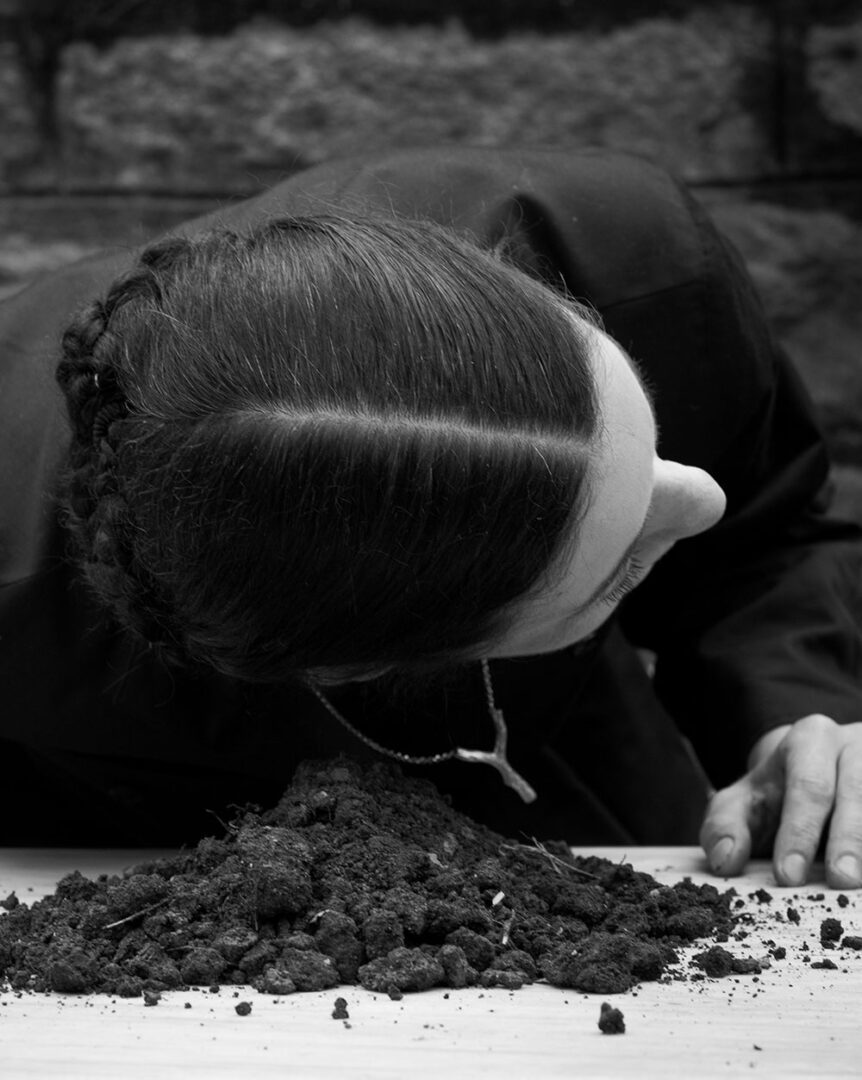
Marzia Migliora (1972, lives and works in Turin) is a visual artist whose research develops through a multidisciplinary language that includes photography, video, sound, performance, installation and drawing, whose recurring root is memory, understood as a tool for understanding the present, giving voice to stories that are often forgotten or marginalized and transforming them into tools of reflection and resistance. At the center of her reflection is the concept of work and its role in the construction of identity, both personal and collective, exploring the contradictions of industrial capitalism, highlighting the effects of this system on bodies, communities and the environment. Her works, in particular, address historical, social and economic issues connected to the production and distribution of natural resources, questioning the dynamics of exploitation and inequality that define our contemporary reality. In his most recent works, the artist has integrated a multispecies perspective into her research, which includes the animal, mineral and plant world, articulating it as a story of the current ecological crisis and the need to reset the relationships between human and non-human towards new modes of reciprocal coexistence.
Migliora’s work has been exhibited in major national and international institutions, including KunstHausWien, Vienna; Palazzo Ducale Genova, Genoa; Villa Schöningen, Potsdam; Arte Sella, Borgo Valsugana; Palazzo Abatellis Regional Gallery of Sicily, Palermo (all 2025); Tai Kwun Contemporary, Hong Kong; MAO-Museum of Oriental Art, Turin; Radius Center for Contemporary Art and Ecology, Delft; Dhaka Art Summit; Fondazione Prada, Milan; MAXXI–Museo nazionale delle arti del XXI secolo, Rome (all 2023); MUCIV-Museum of Civilizations, Rome (2022); Castello di Rivoli Museo d’Arte Contemporanea, Rivoli, Turin and MA*GA, Gallarate (both 2020); OGR-Officine Grandi Riparazioni, Turin and Serlachius Museum, Mänttä (both 2019); Ca’ Rezzonico, Venice (2017); Fondazione Merz, Turin and 56th Venice Biennale/Italian Pavilion, Venice (both 2015); MAMbo-Museo d’Arte Moderna, Bologna (2013); Museo del Novecento, Milan (2011); Le MAGASIN-Centre National d’Art Contemporain, Grenoble (2010); Carré d’Art, Nîmes (2007); FACT-Foundation for Art and Creative Technology, Liverpool (2005); MART-Museo di arte moderna e contemporanea, Rovereto and Fondazione Sandretto Re Rebaudengo, Turin (both 2004); Museo Nacional Centro de Arte Reina Sofia, Madrid (2003). In 2009 and 2023, she received support from the Italian Council program for the production of The Specter of Malthus and for the publication of her first comprehensive monograph, edited by Anna Cestelli Guidi and Matteo Lucchetti.